For immediate clarification, no you can’t be a personal trainer without a qualification.
Many inaccurate sources may argue otherwise, suggesting that you can get around this because ‘personal trainer’ isn’t a protected title. But this article will explain how dangerous pursuing this career without proper training can be, looking at:
- Can You Be a Personal Trainer Without Certification?
- Is it Illegal to be a Personal Trainer Without Certification?
- Are Personal Trainers Regulated?
- Why Are Personal Trainer Certifications Essential?
- What Happens If You Train Clients Without a Certification?
- What Qualifications Do You Need to Become a Certified PT?
- FAQs
Can You Be A Personal Trainer Without Certification?
To become a PT, you’ll need to obtain a Level 4 Personal Trainer Certification.
Employers will always ask to see proof that you’re fully qualified before considering your application. Specifically, they’ll look for candidates who hold a CISMPA-endorsed and Ofqual regulated Level 4 certification.
Even if you want to start your own business, personal training insurance providers will always ask you to provide evidence of your certification before they agree to legally cover you.
Choosing to enter the industry without a qualification will therefore result in a lack of employment opportunities and even potential legal consequences.
However, once you’re qualified, you’ll be able to create customised workout programmes, train clients 1-to-1, and earn a lucrative personal training salary.
Is it Illegal to be a Personal Trainer without Certification?
It isn’t illegal to call yourself a personal trainer without the correct certification. However, it is illegal to operate a business without the correct insurance.
In order to get insured, you’ll need to provide evidence that you’ve completed a Level 4 Personal Trainer Course. If you can’t obtain this coverage, your business would be considered an illegal practice.
Operating without insurance could have further legal repercussions. For example, if a client is injured under your supervision they could make a claim against you, resulting in financial penalties and other more serious consequences.
Therefore, it’s practically impossible to operate professionally as a personal trainer without a certification.
Are Personal Trainers Regulated in Ireland?
Personal trainers are not legally regulated, meaning the title itself is not protected by law.
Ofqual (the Office of Qualifications and Examinations Regulation) does regulate personal training qualifications, just not job titles. Specifically, this government-run organisation creates the ‘level’ structure for courses.
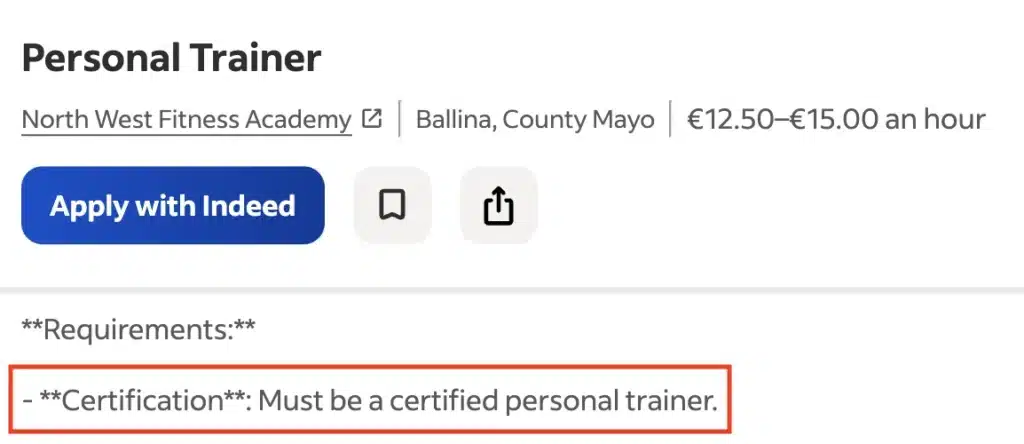
For example, if you see a job advertisement requesting a personal trainer certification like the example below, the employer is requesting candidates with regulated certifications:
CIMSPA (Chartered Institute of Sport & Physical Activity) will also provide endorsement for personal training courses. This organisation ensures all fitness professionals qualify with a high-standard of knowledge and skills to perform their role as a PT effectively.
This is achieved through closely monitoring aspects such as the quality of teaching and learning resources, as well as how the course is delivered.
Why Are Personal Trainer Certifications Essential?
If you’re looking to become a personal trainer getting qualified is absolutely essential for several key reasons.
One of the most important being is that qualifications provide formal training. It’s one thing to have a passion for health and fitness, but it takes a greater level of skill and depth of knowledge to create custom workout programmes and offer 1-to-1 training to clients.
Additionally, employers won’t even consider your application if you aren’t qualified, making it incredibly difficult to even get your foot in the door.
Furthermore, even if you tried to get around this by working on a self-employed basis, you won’t be able to get personal trainer insurance without proof of your qualification. As a consequence, your business will be considered an illegal practice.
On top of all of this, clients can ask for proof of your credentials at any time. Should they discover that you’re unqualified and operating without insurance, they could make a legal claim against you.
To summarise, if you try to enter the personal training industry without the correct certifications, then you’re going to face barrier after barrier. Getting qualified takes a matter of weeks and once you’re certified all these barriers are removed.
You’ll be able to provide proof of your credentials to employers and clients, legally protect yourself with insurance, and work with confidence that you’ve trained to the highest possible standard.
What Happens If You Train Clients Without Certification?
Without regulated qualifications you can’t obtain public liability or professional indemnity insurance. Subsequently, without insurance your business will be considered to be operating illegally.
Public liability insurance covers personal trainers from claims made by third parties such as your clients. Hypothetically, if they are injured during a session due to your advice or faulty equipment you’ve provided, they could make a legal claim against you.
Professional indemnity provides protection in the event a client makes a negligence claim, for example if they believe you’ve given bad advice. This can still affect you even if you’ve given them the correct support, as you’d still be operating without insurance.
The consequences of training clients without a certification can vary depending on the severity of the claims made against you.
You may face financial penalties which you’d have to pay for out of pocket. In severe cases, some unqualified individuals have even faced jail time for injuries that have occurred as a result of their negligence.
What Qualifications Do You Need to Become a Certified PT?

First things first, you’ll need to complete a Level 3 Certificate in Fitness Instructing. This course will qualify you to work as a fitness instructor (also known as a gym instructor) and acts as the prerequisite qualification for your Level 4 PT course.
After completing your Level 3 qualification, you will then need to move on to a Level 4 Certificate in Personal Training. Once you’ve completed this course, you can obtain insurance and start legally working in the role.
The quickest and easiest way to obtain both of these qualifications is through a Personal Training Diploma, which combines both Level 3 and 4 courses.
Each of these qualifications must be Ofqual regulated. Having a qualification that is not regulated is a complete waste of your time, as employers and insurance providers won’t recognise them.
Ofqual is the government body which regulates vocational training courses. This organisation sets criteria for training providers like OriGym to follow, monitoring course content, assessment processes, and delivery methods.
You should also look for personal training certifications that are endorsed by CIMSPA. This acts as a stamp of approval and shows employers you’ve completed a course that meets an industry-agreed standard.
Be sure to check out where training providers land on CIMSPA’s quality assurance framework, as this helps to determine the quality of the course. For example, OriGym was awarded ‘Enhancing’ status, which is the highest mark.
FAQs
Can You Be a Personal Trainer Without Certification?
You can’t legally operate as a personal trainer without certification. Without proof that you’ve obtained a Level 4 Personal Training qualification you won’t be able to get insurance, as a result, your business will be considered to be illegally operating.
Employers in gyms and fitness centres also won’t hire you. Therefore, working in this role without certification is practically impossible.
Are Personal Trainers Legally Regulated?
The job title ‘personal trainer’ is not legally regulated. This leads many to inaccurately assume they can work in the role without first gaining proper certification, but that’s not the case.
The government-run organisation Ofqual regulates personal trainer courses, setting standards for training providers to follow. This includes reviewing various training providers, monitoring their course content, assessment processes, and how the qualification is delivered.
Both insurance providers and employers will check to see if your qualification is Ofqual-regulated, as this signifies you’ve been trained to industry standards.
Do You Legally Need a Qualification to be a Personal Trainer?
Yes, without a Level 4 Personal Training Qualification you won’t be able to get insurance. Should you decide to work without this protection, you’ll be doing so illegally.
As a result, you could face serious legal and financial consequences should one of your clients make a claim against you.
Who Regulates Personal Training Qualifications?
Ofqual (the Office of Qualifications and Examinations Regulation) regulates all vocational training courses, including personal trainer qualifications like those we provide at OriGym.
This ensures a standardisation, as all regulated training providers must adhere to strict guidelines surrounding course content, assessments, and overall delivery. Think of it as a stamp of approval, that you meet industry standards as a personal trainer.
You’ll only be able to legally work as a personal trainer if your qualification is regulated. Without this, neither employers or insurance providers will recognise you as a certified PT.
Is CIMSPA Endorsement Mandatory?
CIMSPA-endorsed personal training qualifications signify to employers that you’ve been trained to the highest standards. Without this, you may struggle to find work as employers have no way of verifying the quality of your training.
Specifically, CIMSPA monitors criteria such as the quality of teaching, assessments, and tutor support. They then provide a grade based on performance, for example OriGym’s was awarded the highest possible ‘Enhancing’ status.
Many employers will specify that they are looking for applicants who hold a CIMSPA personal training qualification in their job applications.
Before You Go
So, you can’t be a personal trainer without a certification. The natural solution to this is to get qualified and begin chasing your dream career.
If you’re eager to get started with your new fitness career, go ahead and check out the range of regulated personal training qualifications that you can study with us here at OriGym.
Alternatively, you can download our free course prospectus to find out more.